keplertech.io

Open EDA tools, built for AI agents and engineers

We don't build the brain. We build the tools any brain connects to.

KeplerTech builds open-source EDA tools designed to be driven by AI agents, and usable standalone by engineers. The tools contain no AI: the agent brings the reasoning, the tools bring exact, reproducible results.

pip install najaeda
Why now

Agentic AI brings new power and new responsibilities to EDA tools

New power

  • Navigate designs far larger than any context window
  • Propose and apply design edits autonomously
  • Iterate much faster than a manual loop

New responsibilities

  • Every agent edit must be proven correct
  • Tools must return exact, structured, bounded answers
  • Results must stay reviewable by an engineer
What KeplerTech builds

A new kind of open EDA tools, designed to be driven by AI agents and engineers

Open source

  • Public on GitHub and PyPI
  • Transparent code: nothing hidden
  • Auditable by your own team

Agent-ready

  • High performance: the agent loop never stalls
  • Multi-threaded; multi-machine extension possible
  • Built on our EDA veteran culture

No AI inside

  • We don't build the brain: we build the tools any brain connects to
  • Fully deterministic: same question, same answer, every time
The agent loop

Explore, edit, verify, show

Our tools give any agent a precise view, a strict checker and a way to show its work.

Your agent

Any AI agent

Any model, any MCP client. It decides; the tools answer.

  1. 1 · Explore

    naja-scope

    Exact, token-bounded answers on RTL and netlists.

  2. 2 · Edit

    najaeda

    The agent applies its RTL or netlist edits through the Python API.

  3. 3 · Verify

    kepler-formal

    The policeman: proves each RTL or netlist edit keeps the same behavior.

  4. 4 · Show

    naja-schematic

    Renders the design and formal diagnoses.

↻ Loop until equivalence is proven
RTL→Synthesis→Netlist→P&R

The agent edits RTL or netlists (refactor, optimize, fix); each change is proven before it is kept.

Lego pieces on one common API

Each tool works on its own, for engineers as well as for agents

Explore

naja-scope

MCP server: drivers, loads, logic cones and source lines, for any MCP client.

17 design questions on CVA6 (RISC-V core)
naja-scope17/17
grep10/17
Input tokens: 182k vs 888k, about 5x fewer
Verify

kepler-formal

Formal proof that two design versions behave identically.

RTL SEC checks the sequential behavior of SystemVerilog before vs after a change. Also gate-level LEC and SEC.

Used by OpenROAD for flow regression, and in hardware CI/CD flows.
Show

naja-schematic

Schematic viewer for netlists and formal diagnoses. Makes results reviewable by humans.

Opens in the browser and in VS Code.
Build

Your own tool

Scripts on the same API: analyze and transform your designs, automate your flow.

pip install najaeda

The common API: naja + najaeda

naja is our open-source C++ netlist engine; najaeda is its Python package. Every tool above is built on them.

najaeda: downloaded tens of times every day, worldwide
Demos

The tools at work

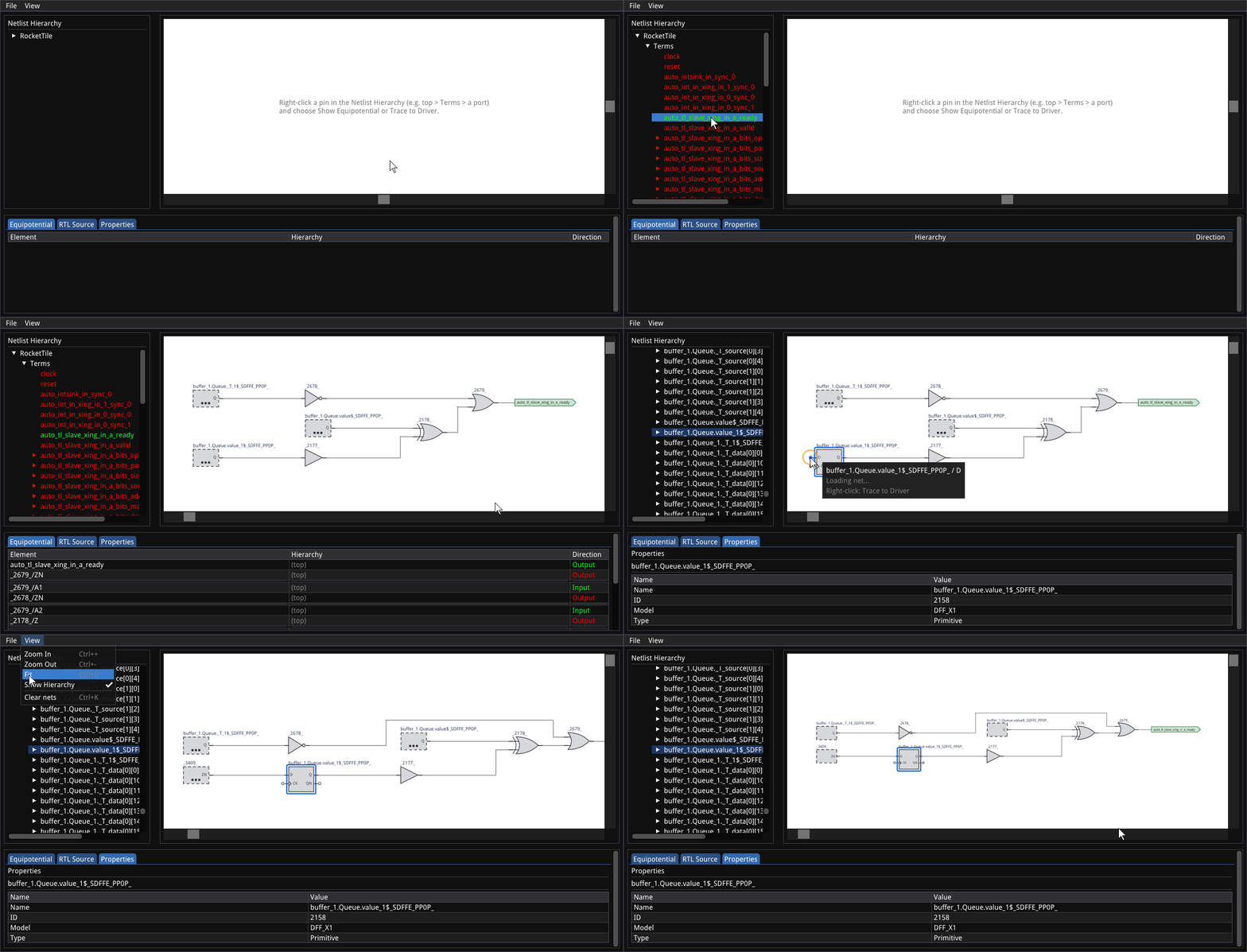
Two short recordings from real sessions: an AI agent exploring a design with naja-scope, and a schematic traced step by step in naja-schematic. Click a recording to open it full size.
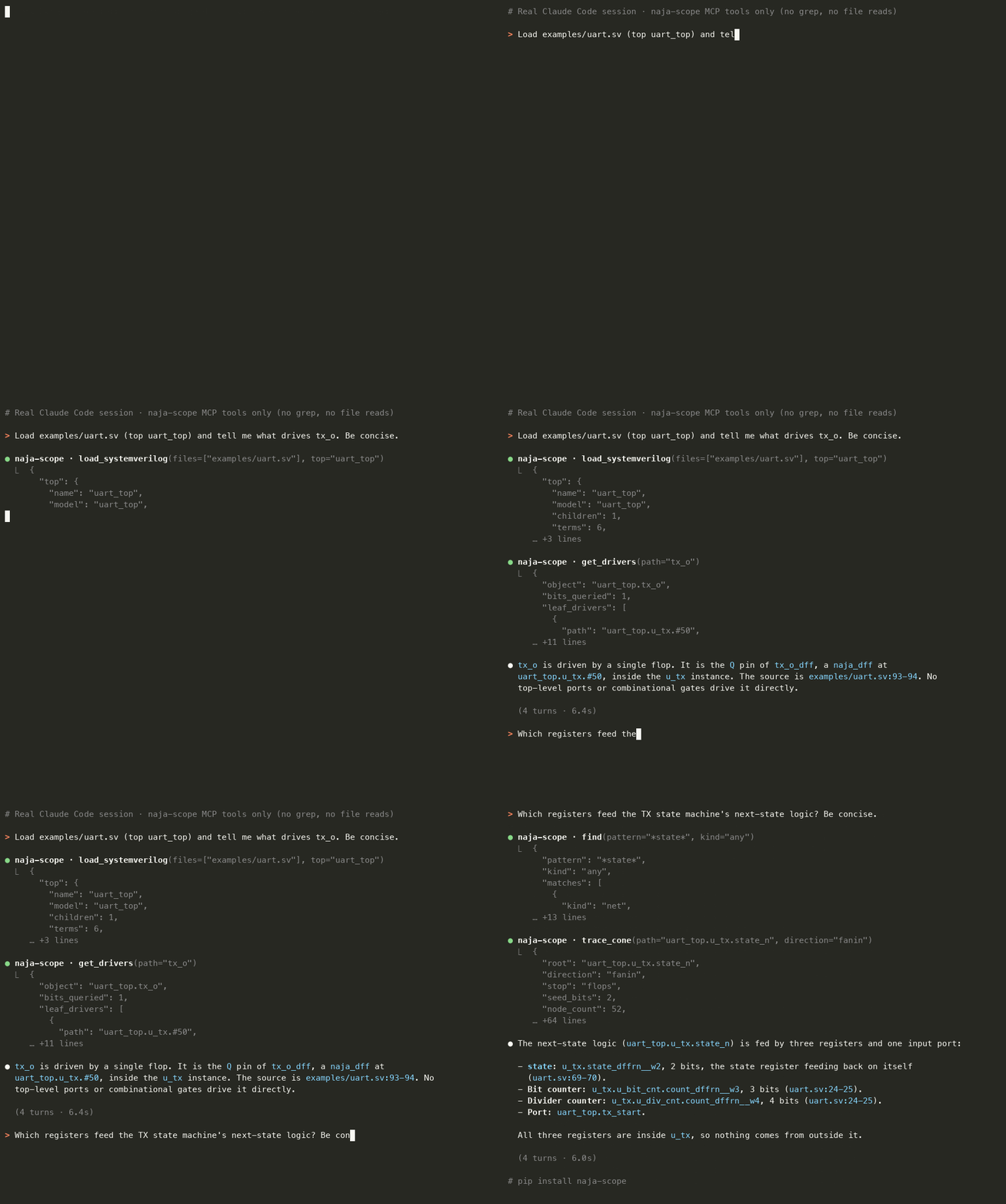
naja-scope demo: a Claude Code session tracing drivers and a fan-in cone on a UART design, using only naja-scope tools
naja-scope in a Claude Code session: tracing drivers and a fan-in cone on a UART design, using only naja-scope tools.
naja-schematic demo: tracing an output port back to its drivers, then extending the schematic pin by pin
naja-schematic: tracing an output port back to its drivers, then extending the schematic pin by pin.
Focus: formal verification

kepler-formal: proof that an edit keeps the same behavior

kepler-formal is an equivalence checking tool for digital designs. It takes two versions of a design, before and after a change, and returns a proof or a counterexample.

RTL SECSequential equivalence checking between two RTL versions: Verilog or SystemVerilog, including file lists with explicit tops. Checks that the sequential behavior is the same before and after a change.
RTL to gate SECSystemVerilog RTL against a Verilog gate-level netlist, with Liberty libraries.
Gate-level SECSequential gate-level netlists, with Liberty libraries.
Gate-level LECCombinational logic equivalence checking on post-synthesis or implementation netlists, with Liberty libraries.

One command

kepler-formal -sv -v sec \
  --sv_design1_flist before.f --sv_design1_top top \
  --sv_design2_flist after.f  --sv_design2_top top

RTL SEC on two SystemVerilog file lists. The same run can be described in a YAML file.

One verdict

  • 0Proved. All checked outputs were proved equivalent.
  • 1Partially proved. Some outputs were proved; the others are inconclusive.
  • 2Inconclusive. Neither a proof nor a counterexample.
  • 3Counterexample found. A definitive mismatch.

SEC exit codes: a script or an agent reads the result without parsing a log.

For agents

kepler-formal-mcp is a local MCP server with three tools: gate_lec, gate_sec and rtl_sec. Each call runs one check and returns a structured result.

The checker only reads design files. It never edits them.

For engineers and CI

Command line or YAML configuration. Liberty libraries, and custom technology primitives written in Python.

The prepared SEC problem can be exported as BTOR2.

In use

Used by OpenROAD for flow regression, and in hardware companies' CI/CD flows.

Apache-2.0 licensed. Supported and funded by NLnet through the NGI0 Entrust fund.

Ecosystem

From design formats to tools

Formats

  • SystemVerilog
  • VHDL
  • Gate-level Verilog
  • Liberty
  • Python libraries
  • naja-ifInterchange

Frontends

  • slangSystemVerilog · third-party
  • naja-vhdlVHDL · beta
  • naja-verilogGate-level Verilog parser

Core

naja

Open-source C++ netlist engine

  • RTL and gate-level designs
  • Hierarchy and bit-level connectivity
  • Primitive functional models
  • Optimization and editing

API

Tools

All open source · dashed outline: third-party component

Business model

Free open-source tools, paid services and specialization

Integration

Our tools plugged into your flows and CI.

Specialization

Custom tools and agent workflows on the naja APIs.

Support

Maintenance, priority fixes and training.

Build your own independent, autonomous EDA with us.

The team

Two technical co-founders, EDA veterans

Leadership at major EDA vendorsChief software architect and R&D managers. Years spent designing commercial EDA software, leading engineering teams and shipping tools used on production designs.
Core expertiseIndustrial-grade open source: the engineering standards of commercial EDA, applied to public code. Experts at solving complex problems on large designs, from netlist engines and compilers to formal verification, with performance and multi-threading as first concerns.